
How to Succeed at Full-Arch Marketing in Today's Competitive Environment
Full-arch marketing has become highly competitive, and not all practitioners have been able to win at it. At Gilleard Dental Marketing, we apply best practices in marketing technology to create successful brands and make marketing succeed.

Why Full-Arch Marketing is More Important Than Ever
One of the most fundamental marketing principles is this: The greater the competition, the more intelligent your marketing needs to be.
Full-arch marketing has entered the stage where the number of competitors in many areas of the US exceeds the demand from potential full-arch new patients. Full-arch treatment has become a buyer’s market, not a seller’s market. There are many products and brands that have experienced the same thing.
What PowerBar Can Teach Us About Full-Arch Marketing
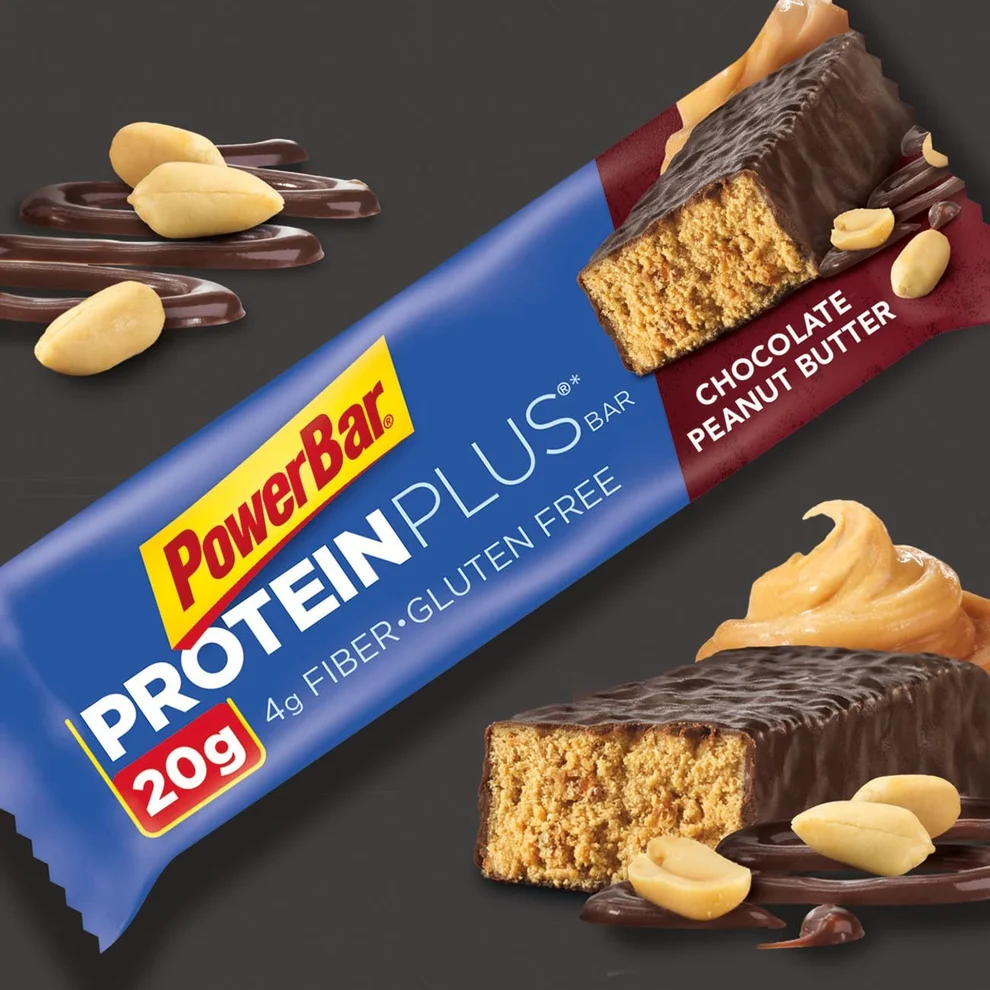
Remember PowerBar? Introduced in 1986, it pioneered the modern protein bar market and enjoyed several years with little direct competition. Its sales grew, but something interesting happened when competitors entered the market: PowerBar's sales grew even faster.
Why? The competitors weren't simply taking customers away. Their combined advertising helped introduce more consumers to protein bars, dramatically expanding the market. As the market grew, brands began differentiating themselves. Some emphasized high protein, others targeted women, weight management, natural ingredients or particular athletic needs. They were applying intelligent marketing to capture their share of the potential market.
PowerBar's annual sales reached approximately $142 million in 1999. But eventually, the pioneer lost its competitive advantage. By 2023, its North American business had dwindled to $7.7 million in annual sales and was discontinued. Today, there are 256 brands and 1,710 different protein bars. The market PowerBar helped create became enormous, but the original pioneer could no longer compete effectively in North America.
The lesson? In the beginning there was a gravy train everyone could ride. As more competitors entered the marketplace, the supply exceeded the demand, and only the most intelligent marketers, or the ones with the most money to invest, survived.
Full-Arch Marketing Followed a Similar Path
The All-on-4® treatment concept was developed in the 1990s and introduced commercially in 2004. Advances in implant technology and surgical techniques made fixed full-arch treatment faster, more practical and accessible to more patients.
During the 2010s, full-arch treatment became increasingly mainstream. Early advertisers such as ClearChoice helped introduce consumers to the possibility of replacing failing teeth or dentures with fixed teeth. As more dentists began advertising, awareness and demand grew. For a time, simply promoting New Teeth in One Day could generate considerable interest. But that early advantage couldn't last.
Today, independent dentists compete with local implant specialists, regional groups and national implant center chains, many with substantial advertising budgets.
The procedure itself is no longer the competitive advantage. Patients can get full-arch treatment from numerous providers. The question is why should they choose you?

What's Wrong With Today's Full-Arch Marketing?
Many digital marketing agencies rely heavily on the same formula: Facebook advertising, a landing page, a compelling offer and a call center to manage the leads.
This approach can work. But it often requires substantial advertising investment, efficient lead handling and strong case acceptance. And when several competitors are using essentially the same approach, acquiring patients becomes increasingly expensive.
Large implant centers have differentiated themselves in order to stay competitive. Nuvia promotes permanent teeth in approximately 24 hours. Affordable Dentures & Implants emphasizes price. ClearChoice increasingly promotes experience, quality and long-term support. As well as heavy investment in marketing, these companies are building their distinctive brand.
They're not simply advertising full-arch treatment. They're giving new patients reasons to choose their particular brand. Independent dentists need to do the same.
Don't Have the Budget? Here's What You Can Do
When the competition is heavy, the usual full-arch marketing model of Facebook/Google Ads plus agency fees and call center only succeeds if a high budget is invested. Not all dentists have the budget for it. Some might omit the call center, but can get quickly frustrated about handling the colder leads generated by Facebook. The answer is the application of intelligent marketing.
What should your marketing be doing?
- Capture existing demand from people already searching for implant or full-arch treatment.
- Create demand among people who need treatment but aren't actively looking for it.
- Convert demand into patients by establishing why your practice is the right choice.
This requires three complementary marketing tools.

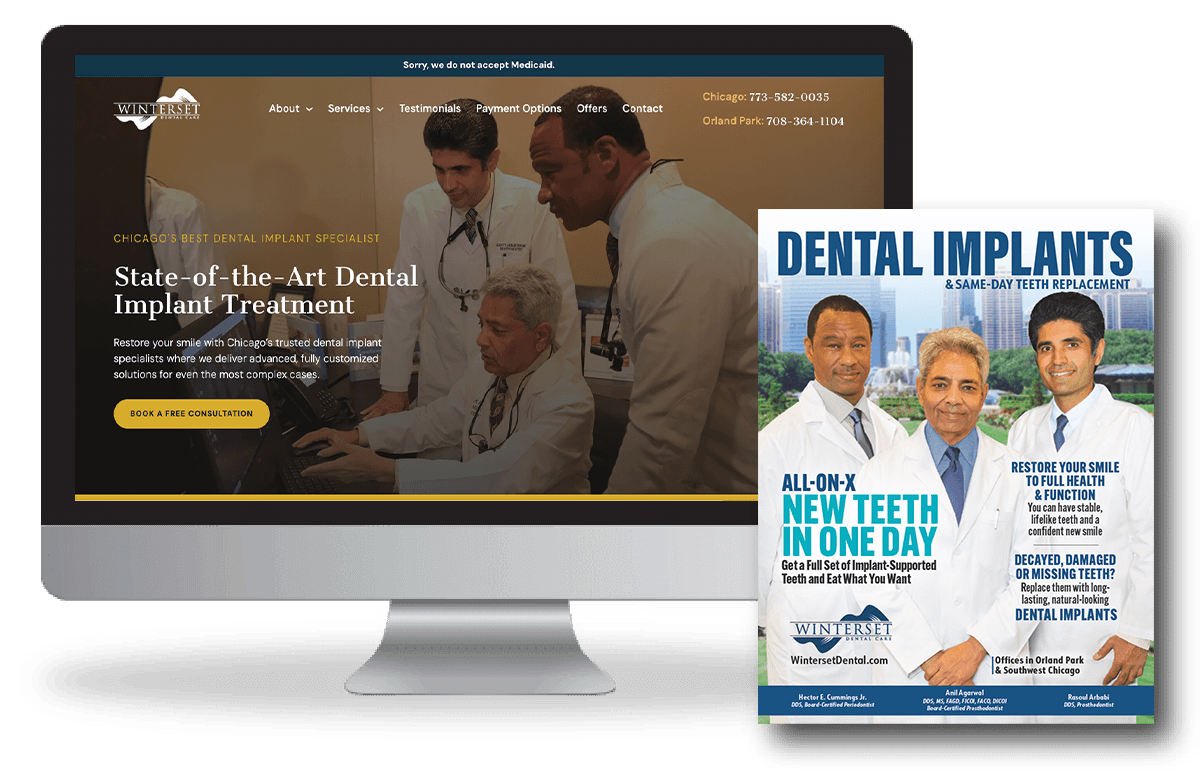
1. A Website That Demonstrates Your Expertise
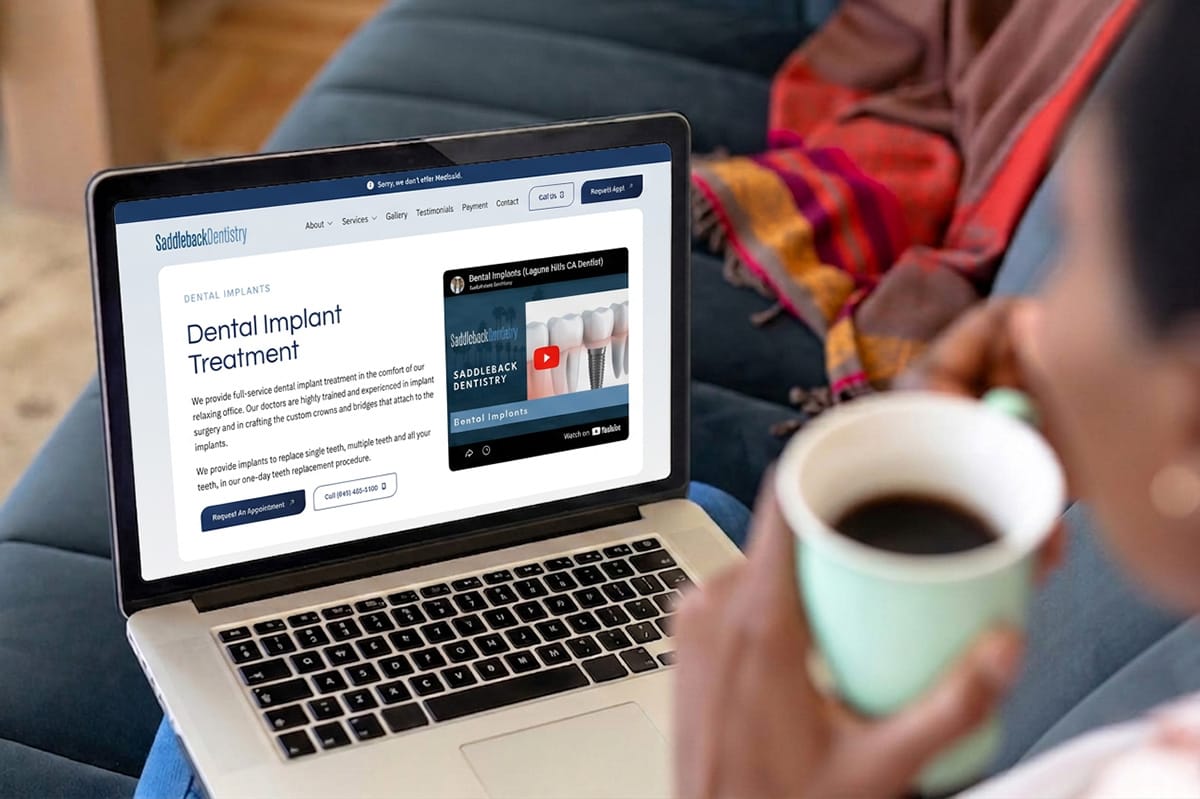
Your website is the foundation of your brand. It must convince prospective patients that your practice has the experience, skills and technology to deliver excellent full-arch treatment. That means:
Real, custom content that demonstrates your knowledge and approach, not generic or AI-generated copy.
Excellent practice photography showing your actual doctors, team, office and technology, rather than relying on stock images.
A compelling doctor presentation featuring relevant credentials, experience and training.
Real patient results with before-and-after photographs, testimonials and videos.
Strong implant and full-arch pages. Don't invest in a beautiful home page only to fill your procedure pages with generic content and stock photography.
A competitive reason to take action, such as a complimentary consultation or attractively priced examination, X-rays and CT scan.
Your website must also be optimized for search engines so patients looking for implant treatment can find you. And it needs to be convincing even if you use separate landing pages for advertising. Prospective patients will often visit your main website to investigate your practice before making a decision.
If full-arch treatment is a major focus of your practice, that expertise should be apparent throughout the website. You don't need to become an implant-only practice, but you shouldn't look like an everyday dental office that happens to offer implants. Don't just claim expertise. Demonstrate it.
2. Focused Digital Advertising
Digital advertising remains an important part of full-arch marketing. But you don't necessarily need to compete in the expensive, high-volume lead-generation game.
Google Search advertising can reach people actively looking for implant or full-arch treatment. These are often valuable prospects because they already recognize a need and are investigating their options.
Well-targeted campaigns, supported by strong landing pages or website content, can help attract these high-intent patients without requiring the enormous budgets associated with broad lead-generation campaigns. Facebook and Instagram can also play a role, particularly in building awareness and reinforcing your brand.
The objective isn't simply to generate the greatest number of leads. It's to attract qualified prospective patients who have good reasons to choose your practice.

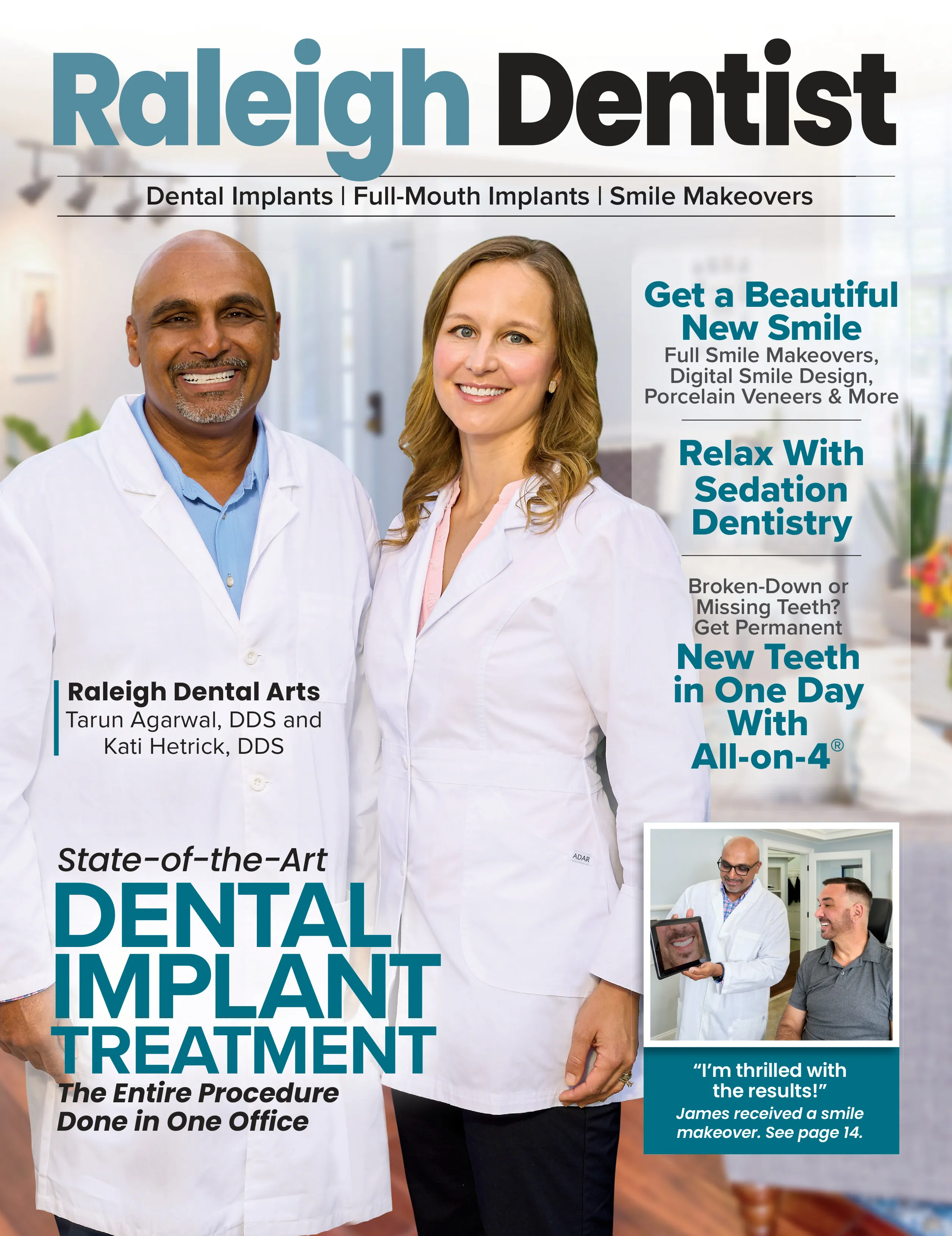
3. A Custom Magazine That Creates and Strengthens Demand
Here's where most digital-only marketing companies miss an important opportunity. Digital advertising reaches people searching online or scrolling through social media. But what about the many people who need extensive dental treatment and aren't doing either?
They may be struggling with failing teeth, uncomfortable dentures or difficulty eating. Some don't know what modern full-arch treatment can accomplish. Others know about implants but haven't decided where to go.
A custom educational magazine reaches these people directly in their homes. It explains their treatment options, demonstrates the dentist's expertise, features real patient results and establishes the practice as a credible local provider. Unlike a brief digital advertisement, a magazine gives prospective patients the opportunity to learn about the procedure and the doctor in depth, at their own pace.
And it works alongside digital marketing. Someone who receives a magazine may subsequently search for the practice online. Someone who has seen digital advertising may recognize the practice when the magazine arrives. The magazine creates and strengthens demand. Focused digital advertising captures demand. The website helps convert that demand into patients.
The Bottom Line
PowerBar helped pioneer a market that eventually became much larger than anyone could have imagined. But as competitors multiplied, simply being an established energy bar brand was no longer enough.
Full-arch dentistry has followed a similar path. Advertising helped create awareness and demand, but now patients have many providers to choose from.
The solution isn't necessarily to spend more money chasing the same leads as everyone else. It's to build a brand that patients recognize, trust and have compelling reasons to choose — using a strong website, focused digital advertising and a custom magazine that reaches people your competitors may be missing.
Schedule a free consultation to discuss the right marketing strategy for you.
Tell us what you’re trying to grow, and we’ll walk you through how we’d approach it. No pressure, no generic pitch.