
How much does dental marketing cost in 2026? If you’re trying to grow your practice, this is what you should realistically expect to spend.
Dental marketing cost can vary a lot depending on your goals, but most practices fall into a pretty predictable range.
If you’ve been looking into dental marketing, you’ve probably seen:
- “It depends”
- “Custom pricing”
- “Schedule a call”
That’s not helpful when you’re trying to figure out what this actually costs.
So here’s a straight answer based on what practices are really paying right now.
The short answer on dental marketing cost
If you want marketing that actually brings in patients, here’s what it typically looks like:
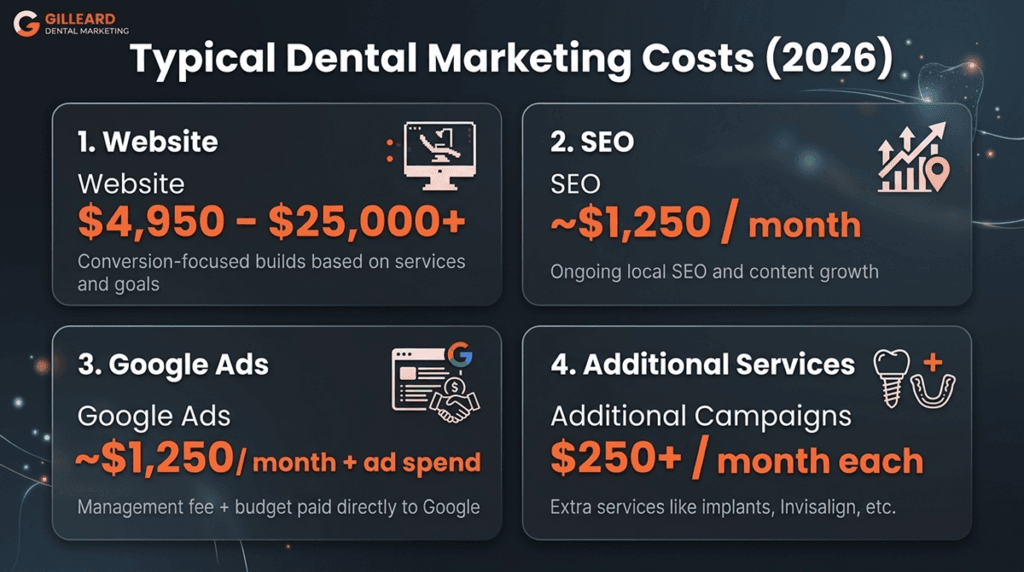
Website (one-time)
- Around $4,950 for a clean, conversion-focused site
- Around $8,500 for a more built-out site with multiple services
- Around $15,000 – $22,500 for practices focused on implants or higher-value treatments
- $25,000+ for fully custom, top-end builds
Ongoing marketing
- Google Ads management: about $1,250/month (plus ad spend paid to Google)
- SEO: about $1,250/month
- Additional campaigns or services: typically $250+/month each
Most practices end up somewhere around:
$1,250 – $3,000+/month ongoing
Why dental marketing cost is all over the place
Here’s what most agencies don’t explain well.
Not all marketing is trying to do the same thing.
There’s a big difference between:
- filling hygiene chairs
- and bringing in $20k–$40k cases
Those require completely different:
- messaging
- pages
- strategy
That’s why you’ll see such a wide range in pricing.
What you’re actually paying for
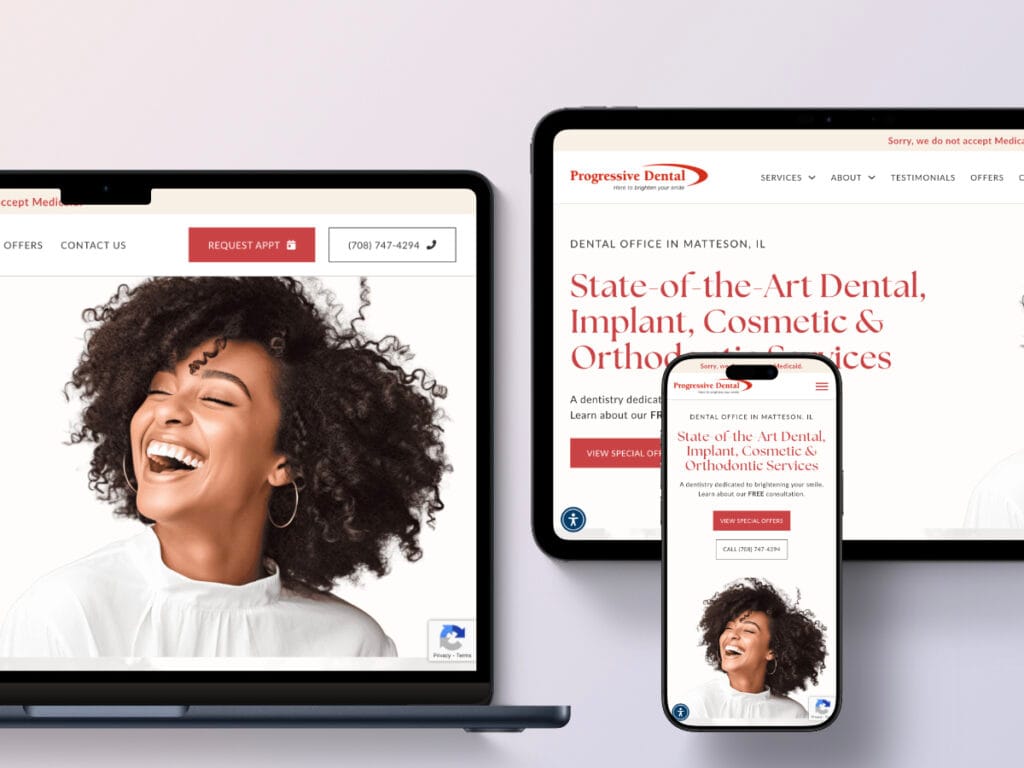
1. Your website (this is where everything lands)
Every click, every referral, every search ends here.
If your site is weak:
- people leave
- they don’t call
- they don’t trust it
A basic site gets you online.
A well-built site actually converts.
That difference matters more than anything else you’ll spend money on.
2. Google Ads (fastest way to get patients)
If you want results now, this is usually the lever.
But this is also where many practices waste money.
Common problems:
- ads pointing to bad pages
- generic messaging
- no focus on higher-value treatments
Management is usually around $1,250/month, plus your ad spend.
When it’s set up right, it works.
When it’s not, it just burns money.
3. SEO (what builds over time)
SEO is how you show up consistently when people search:
- “dentist near me”
- “dental implants [city]”
At around $1,250/month, you’re building:
- visibility
- content
- local presence
It’s slower, but it stacks over time.
4. The part most people miss: messaging
This is where most marketing fails.
Different patients are thinking differently.
Someone looking for:
- Invisalign
- implants
- full-mouth reconstruction
They’re not in the same mindset.
If your marketing treats them the same, it doesn’t connect.
Where custom magazines fit in
Most agencies ignore this completely.
But for the right practices, it’s one of the strongest tools you can use.
Custom magazines work because:
- you control the entire story
- there’s no competition on the page
- you build trust before someone even searches
This isn’t a low-cost tactic.
It’s for practices that want to position themselves differently and attract higher-value cases.
Cheap vs expensive marketing
Cheap marketing usually means:
- templates
- generic copy
- minimal strategy
More expensive marketing usually means:
- better positioning
- stronger conversion
- higher-quality patients
But price alone doesn’t guarantee results.
Execution does.
What you should realistically budget
This is where most discussions of dental marketing costs become more realistic.
If you’re just trying to grow steadily:
$1,250 – $2,500/month
If you want to push higher-value cases:
$2,500 – $3,000+/month
Plus your initial website investment if needed.
Anything significantly below that usually means:
- not enough is being done
- or it’s not being done well
What most dentists get wrong about marketing cost
Many practices try to spend as little as possible at the outset.
That usually leads to:
- weak websites
- underperforming ads
- inconsistent results
Then they end up spending more later trying to fix it.
The better approach is to view dental marketing costs as an investment, not just an expense.
If your marketing is done right, it should pay for itself by bringing in the right patients.
Final thought
Marketing isn’t about getting more leads.
It’s about getting the right patients.
That’s what actually grows a practice.
Want a straight answer for your practice?
If you’re not sure what makes sense for your goals, we can take a look and give you a clear direction.
No pressure. Just clarity.